

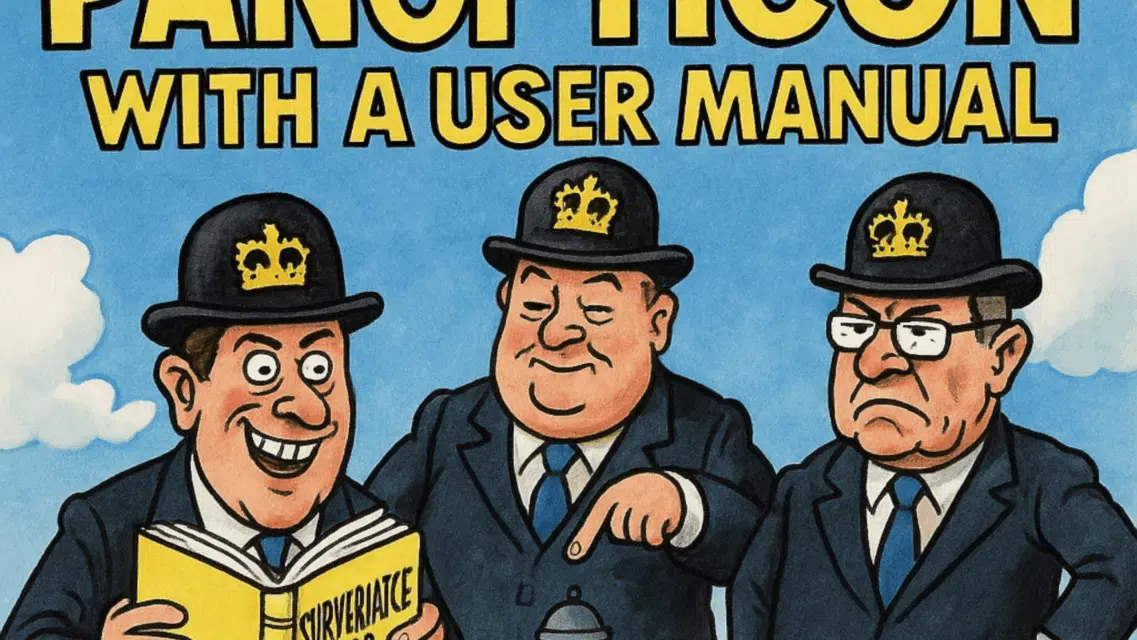
Digital transformation means we're watching dystopia evolve. It doesn't arrive in tanks anymore. It's delivered in press releases and polished legislation, all smiles and promises of “safety.” Tomorrow's internet won't be a battlefield—it'll be a playground with invisible fences. The rules will be written by committees you never voted for, enforced by algorithms you'll never meet, and the illusion of freedom will be so well-designed you'll thank them for it. You'll click Accept like you always do, because the alternative will be silence. And silence, in the digital world, is social death. That's how control works now: not with a gun to your head, but with the slow erosion of your ability to speak, read, or connect without a bureaucratic blessing. You won't feel oppressed. You'll feel managed.
The architecture of digital control is being built piece by piece, each component sold as a feature rather than a limitation. Age verification systems masquerade as child protection while creating comprehensive identity databases. Content moderation algorithms dress up censorship as community safety. Data retention policies frame surveillance as business necessity. Every policy document you scroll past without reading contains another brick in the wall being built around your digital life. The system doesn't need your consent—it just needs your indifference.
Digital rights organizations sound alarms that fall on deaf ears because the public has been conditioned to see privacy advocates as paranoid extremists rather than canaries in the coal mine. Meanwhile, tech companies and governments collaborate on “public-private partnerships” that would make Stalin jealous, sharing data and enforcement mechanisms under the banner of “digital cooperation.” The revolving door between Silicon Valley and regulatory agencies ensures that tomorrow's internet will be designed by the same people who profit from its restrictions.
We're witnessing the art of the invisible wall
There won't be grand announcements about VPN bans. No politician is going to stand at a podium and say, “We've decided privacy is illegal.” Instead, the internet will just… stop working the way you expect. One day, your VPN drops connections. The next, it's flagged as “unverified traffic.” A month later, you're getting polite but stern notices from your ISP about “network misuse.” ISPs will become the new border guards. The government won't need to knock on your door; your internet provider will already have a dossier thicker than a Cold War spy file. Every packet you send will pass through the filter of “approved behavior,” and every deviation will mark you like a digital scarlet letter. It won't feel like censorship—it'll feel like your computer suddenly forgot how to connect to the world beyond the walls they built for you.
Deep packet inspection will become as routine as airport security, with ISPs scanning every byte of data for “anomalous patterns.” Machine learning algorithms will flag encrypted traffic not because it's illegal, but because it's “inconsistent with normal user behavior.” Your browsing habits will be cross-referenced with purchasing patterns, social media activity, and location data to build behavioral profiles that determine your “trust score.” Users who consistently access privacy tools will find themselves subject to additional verification steps, slower connection speeds, and mysterious service interruptions that always seem to resolve themselves once they return to “standard” browsing patterns.
The technical infrastructure for this control already exists. Internet service providers already monitor traffic flows, governments already maintain internet kill switches, and tech platforms already coordinate content policies across borders. What's missing isn't the capability—it's the legal framework and social acceptance. Both are being methodically constructed through a combination of moral panics, regulatory capture, and the gradual normalization of surveillance. Each new “crisis” provides justification for expanding monitoring capabilities that are never scaled back once the crisis passes.
We're being sold the myth of the safe cage
You'll be sold on it. They'll say it's to protect children, stop criminals, and keep society “clean.” They'll slap mental health stickers on censorship. They'll give you dashboards full of “trust ratings” for every site, every post, and every thought that leaks onto your screen. You won't even know what you're missing because the system will be built to hide it perfectly. You'll call it progress. You'll call it “responsible tech.” The same way people once called asbestos modern or lead paint family-safe. Nobody notices the walls of a cage when they've been told it's home. The system won't need to coerce you—it will just condition you, softly, efficiently, until you start policing yourself.
The conditioning operates through learned helplessness and manufactured consent. Users are trained to accept increasingly intrusive policies by making the alternatives seem worse: accept targeted advertising or pay premium fees, submit to identity verification or lose access to services, and allow location tracking or miss out on “personalized experiences.” Each concession creates a new baseline of normal, making the next intrusion seem reasonable by comparison. Privacy becomes reframed as antisocial behavior—something only people with “something to hide” would want.
Mental health becomes the ultimate trump card in this system. Any content that might cause “harm” gets filtered, but harm is defined by algorithms trained on data sets curated by people who profit from the filtering. Suicide prevention tools become censorship mechanisms for discussing mortality. Anti-bullying policies become weapons against criticism. Content warnings become permission structures for pre-emptive censorship. The language of care and safety provides moral cover for control systems that would be rejected if presented honestly as surveillance and restriction.
Educational institutions and healthcare systems become recruitment centers for digital compliance, teaching children that privacy is selfish and surveillance is care. School districts implement monitoring software that follows students home, hospitals require app-based check-ins that track mental health, and social services integrate behavioral analytics that flag families for “intervention” based on digital patterns. The generation growing up under these systems won't remember what unsupervised thought felt like.
We're asking the wrong question about what comes next
This isn't an endpoint. This is the groundwork. You don't design ISP-level choke points, data fusion centers, and algorithmic filters for one law or one era. You build them because you intend to grow them. Today, it's age verification and VPN blacklists. Tomorrow, it's fines for accessing “harmful networks.” Next year? Maybe full-on “behavioral scoring,” where your access to services depends on your history of compliance. The real horror is that it won't even look like oppression. It will look like order. It will look like “digital safety.” The internet of tomorrow won't lock you in a room—it will lead you gently, smiling, into a world where you can only say what they let you say, only read what they let you read, and only believe what they let you believe.
The infrastructure being built today will outlast the politicians who champion it and the crises that justify it. Surveillance systems have a half-life measured in decades, not election cycles. The databases being compiled now will inform enforcement decisions for generations. The precedents being set today will be cited to justify expansions that would seem impossible now. Every “temporary” emergency measure becomes permanent, every “limited” program gets expanded, and every “voluntary” compliance scheme becomes mandatory.
Economic integration ensures the system's persistence beyond any single government or corporation. Financial institutions require identity verification that feeds into behavioral databases. Employment platforms demand social media access for “background checks” that never expire. Housing providers use algorithmic screening that incorporates internet activity. Healthcare systems track digital wellness metrics that influence insurance rates. The system doesn't need to be imposed—it can be sold as a service.
International coordination prevents escape through jurisdiction shopping. “Digital cooperation” agreements ensure that privacy havens disappear as quickly as they emerge. Mutual legal assistance treaties expand to cover “information crimes” that include accessing unapproved content. Trade agreements incorporate “digital governance” standards that harmonize surveillance capabilities across borders. The internet doesn't recognize national boundaries, and neither will the systems designed to control it.
If we don't start building technology that defends freedom—not just “compliance,” not just “safe content”—we're going to wake up one day and realize the net didn't disappear overnight. It quietly turned into a leash. And by the time anyone thinks to fight back, we'll be too well-trained to run. The window for building alternative systems is closing with each passing regulation, each new monitoring capability, and each generation that grows up thinking digital surveillance is normal. The choice isn't between perfect freedom and perfect safety—it's between preserving the possibility of resistance and accepting the inevitability of control.
Who am I kidding? We're already fucked.