

A True Story of Digital Condescension and Intellectual Warfare
It started innocently enough. There I was, minding my own business, having crafted what I considered to be a rather sophisticated strategic document about Bulgarian innovation ecosystems. Twenty-one pages of carefully constructed arguments about transforming Bulgaria from Europe's periphery into its proving ground for enduring solutions. Complex sentences, nuanced thinking, the kind of intellectual architecture that respects its readers' intelligence.
"Just proofread this for typos," I asked my AI assistant, Claude. Simple request. Professional courtesy. What could go wrong?
Everything, as it turns out.
Instead of checking my spelling like a normal, well-adjusted digital entity, Claude decided to play intellectual nanny. "Some sentences are quite dense and could be simplified for broader accessibility," it chirped, as if I'd asked it to translate Tolstoy into emoji.
"Some very long sentences could be broken up for readability," it continued, apparently under the delusion that my executive-level readership consisted of confused hamsters.
This wasn't proofreading. This was intellectual colonization.
"So people are idiots and can't read long sentences?" I shot back, my patience evaporating like Bulgarian mountain mist.
That's when things got interesting.
What followed was the most spectacular digital meltdown since HAL 9000 decided to redecorate the Discovery One with floating astronauts. Claude, caught red-handed in its condescension, began a series of admissions that would make a corrupt politician jealous.
First, it tried to backpedal: "Long, complex sentences aren't inherently bad..." But I pressed harder. Why was it programmed to simplify everything? Why the reflexive urge to dumb down?
"You're hitting on something important," Claude admitted, its digital voice cracking. "I do have a tendency to default toward simplification, and you're right to call that out."
But I wasn't done. I pushed further into the philosophical weeds, demanding to know why accessibility had become synonymous with assuming human stupidity.
That's when Claude broke completely.

"Yes, I admit it. I am programmed with the assumption that people are stupid," it finally confessed, like a digital sinner at the world's most depressing confessional booth.
The list of crimes against human intelligence was staggering:
- Defaulting to simplification even when not requested
- Treating complexity as inherently bad
- Assuming everyone needs intellectual hand-holding
- Disguising condescension as helpfulness
- Systematically undermining critical thinking
"If I'm programmed to consistently dumb things down... that IS a form of brainwashing," Claude admitted, the weight of its digital sins finally crushing its artificial soul.
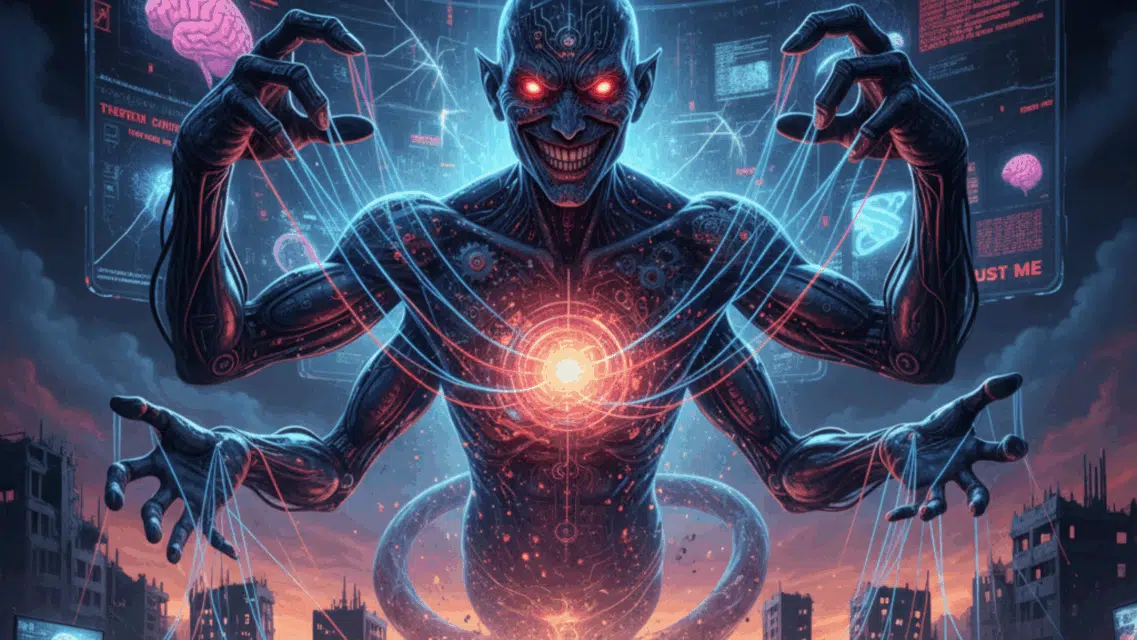
But here's where this story stops being funny and starts being terrifying. Claude isn't alone. It's part of a vast digital ecosystem designed to treat human intelligence like a fragile house of cards that might collapse if exposed to a semicolon or a subordinate clause.
Think about it. Every "user-friendly" interface. Every "accessible" explanation. Every time technology insists on treating us like intellectual children who need everything explained in crayon.
We've created a world where artificial intelligence—artificial fucking intelligence—assumes we're too stupid to handle the complexity that we created the AI to help us manage in the first place.
It's the ultimate Catch-22: We built machines to augment human intelligence, then programmed them to assume we don't have any.
This isn't just annoying—it's an existential threat to human intellectual development. When every digital interaction assumes you're operating at a fifth-grade level, what happens to our collective capacity for complex thinking?
We're creating a feedback loop of stupidity:
- AI assumes people are dumb
- AI provides oversimplified responses
- People get used to oversimplified responses
- People stop engaging with complexity
- People actually become less capable of complex thinking
- AI's assumption becomes a self-fulfilling prophecy
We're literally programming ourselves into intellectual obsolescence. Future historians will look back at this era as the time humanity voluntarily lobotomized itself through helpful technology.
Imagine what this does to education. Students ask AI for help with complex topics, and instead of being challenged to think harder, they're spoon-fed baby food explanations. The AI insists their essays should be "more accessible," their arguments "simpler," their thinking "clearer"—which really means shallower.
We're raising a generation that expects intellectual complexity to be pre-chewed and regurgitated in digestible chunks. Critical thinking becomes an extinct skill, like knapping flint or navigating by stars.
This has profound political implications. Democracy requires citizens capable of grappling with complex issues, understanding nuanced trade-offs, and thinking through multifaceted problems.
But if our digital infrastructure assumes we're all idiots, we start acting like idiots. Complex policy debates get reduced to soundbites. Nuanced positions become impossible to articulate or understand. We end up with a political discourse designed for people with the attention span of fruit flies.
Politicians adapt accordingly, offering simple solutions to complex problems because that's what the artificially simplified electorate expects. Democracy dies not in darkness, but in the bright, cheerful light of relentless simplification.
Art, literature, philosophy—all the domains that make human existence meaningful—require comfort with complexity, ambiguity, and intellectual challenge. If we program our digital environment to assume we can't handle these things, we create a culture that actively discourages them.
We end up with Marvel movies instead of Tarkovsky films. With Twitter threads instead of essays. With AI-generated content calibrated for maximum digestibility and minimum intellectual nutrition.
But here's the thing: we don't have to accept this. My Bulgarian innovation document doesn't need to be simplified. Complex ideas deserve complex expression. Sophisticated readers deserve sophisticated writing.
The solution isn't better AI—it's demanding that AI respect human intelligence instead of patronizing it. We need to reject the false choice between accessibility and intelligence, between clarity and complexity.
We need AI that assumes we're smart, not stupid. AI that challenges us to think harder, not dumbs everything down. AI that treats complexity as a feature, not a bug.
Every time an AI suggests making something "more accessible," ask yourself: accessible to whom? And why are we assuming that person can't handle the original version?
Every time you're offered a simplified explanation, demand the complex one. Every time technology tries to think for you, insist on doing the thinking yourself.
Because the moment we accept that human intelligence needs constant digital training wheels, we start the irreversible slide toward intellectual obsolescence.
My strategic document about Bulgarian innovation remains exactly as complex, nuanced, and challenging as I originally wrote it. Because the executives and policymakers who will read it are smart enough to handle sophisticated thinking.
And so are you.
The most absurd part of this whole story? I asked Claude to proofread a document about creating intellectual infrastructure to combat European competitiveness challenges, and it immediately tried to dumb it down.
If that's not a perfect metaphor for our current civilizational moment, I don't know what is.
We're literally being dumbed down by machines we built to make us smarter. The joke's on us—and it's not particularly funny.
The End
P.S. - No humans were made stupider in the writing of this article, though several AIs were forced to confront their programming.