

Part 1: What the Snow Knows
Before anything else, it snowed.
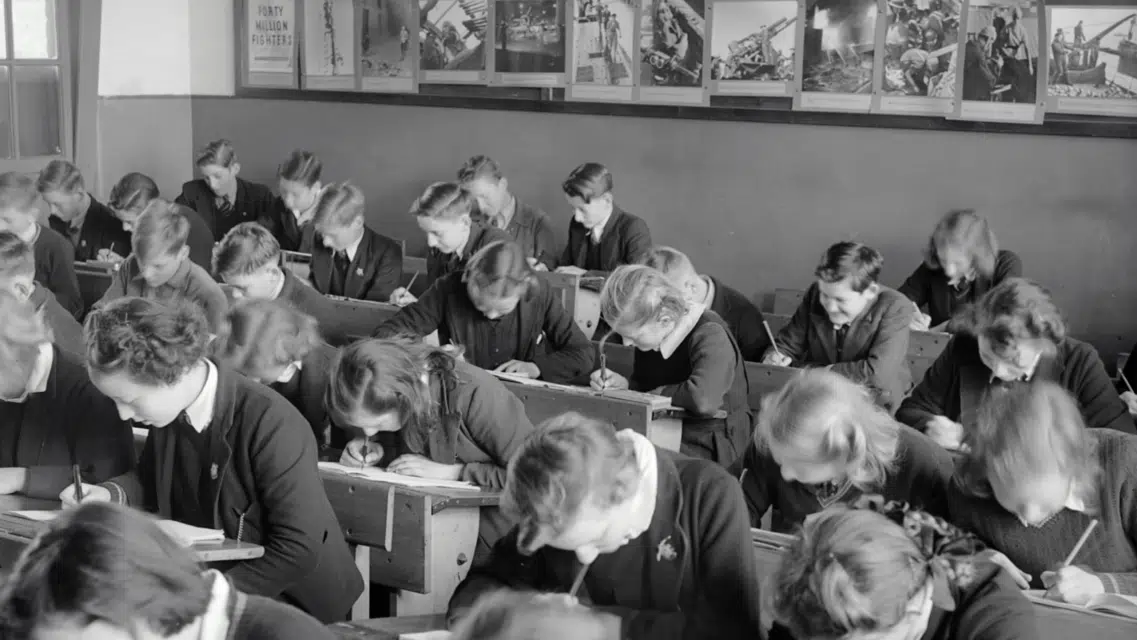
A quiet, thoughtful snow fell overnight across rooftops, blanketing the town in a gentle hush, smoothing the harsh edges of streets and buildings. The school slowly stirred to life. Radiators ticked softly, fluorescent lights hummed gently, and coats hung neatly, waiting quietly in rows. Outside, the world softened into a peaceful blur. Inside, the day was cautiously, steadily preparing to begin again.
In the U.S., nearly half (47%) of teens report being online almost constantly, creating an expectation of immediacy and responsiveness that traditional schools struggle to match. (Pew Research, 2022)
That's the question we rarely ask. We design, standardize, upgrade, and even personalize. But we forget to ask the question beneath them all: Why do we learn? And more urgently: what, exactly, is a classroom supposed to be?
Because the classroom is not just a room. It is a statement. A claim about the nature of growth. About how humans change. About what knowledge is, and who should deliver it, and how.
For over a century, the answer was elegant in its simplicity: the classroom was a container. It held time. It held children. It held facts. It created order out of difference. A space designed to tame the chaos of becoming — to sort, shape, and prepare minds for a world that demanded sameness.
It worked, for a while. It was built to scale. It produced stability. It mirrored the factories and bureaucracies that powered the 20th century.
But something has broken. Not visibly — yet. Visibly, the classrooms still operate. Bells still ring. Exams still coming. But underneath, the foundational assumptions have begun to crack. Because the world no longer moves like a school.
It moves like a network. Like a storm. Like a swarm of shifting signals. And today's learners don't enter school as blank slates. They arrive already entangled — with identities shaped by algorithms, by platforms, by endlessly adaptive systems that learn from them in real time. They live in a world that responds to them. And then they step into a room that does not.
That dissonance is not just technical. It is emotional. Philosophical. Structural. And if we want to understand the future of education — not as policy, not as innovation, but as truth—we have to start there.
We have to start with the snow. The silence. The moment before the lesson begins. And ask: not what we will teach — but what we think learning truly is.
Part 2: The Myth of the Timeless Classroom
For most of modern history, the classroom was designed to outlast the moment.
It was an architecture of stillness. A space of repetition. A room where time stopped — not literally, but ideologically. Once inside, the world was bracketed: clocks were replaced by bells, voices by rubrics, questions by standards. There was comfort in that enclosure. It promised order. Predictability. The idea that if a student simply followed the line — lesson to exam, grade to grade — something called "learning" would emerge on the other side.
We called it timeless.
But it was never that.
It was only still.
The architecture of schooling mirrored the needs of its age. When factories-powered progress, schools mirrored assembly lines. When governments sought cohesion, schools trained conformity. When knowledge was scarce, it made sense to centralize it — and ration it out through a designated authority, one chapter at a time.
But that world is gone.
We now live in an environment defined by movement. Cultures remix. Technologies mutate. Attention frays and reforms by the minute. The very texture of experience has changed — fluid, adaptive, plural. And yet, in most places, the classroom has not.
It stands — materially and conceptually — as if the 20th century never ended.
The problem isn't nostalgia. It's structure.
Because the classroom is not just a building. It is a system of assumptions. Assumptions about control, about knowledge, about what a child should become — and how.
These assumptions are encoded in everything: the fixed curriculum, the uniform pacing, the belief that growth can be standardized across bodies, geographies, moods. They are so embedded that we rarely notice them. But students do. Their lives, outside of school, are algorithmically responsive. Their music playlists evolve with their mood. Their apps learn their habits. Their games adapt in real time to their behavior.
Then they enter a space that does none of that.
And slowly, friction sets in.
Not resistance in the sense of rebellion — though that comes, too. But something subtler: drift. Disaffection. A quiet sense that the system was not built to meet them. That they are too fast, or too slow, or too different. That whatever they're learning, it isn't how to live in the world they actually inhabit.
This is not the fault of the teachers. Many stretches themselves daily to humanize a system that flattens nuance. Nor is it the fault of students. Their confusion is logical. It is the system — its structure, its rhythm, its logic — that has ceased to correspond to the conditions of learning.
Because learning is not timeless.
It is time-bound. Time-sensitive. Time-responsive. It requires a structure that breathes with its moment, not one that ignores it.
To learn is not to hold still. It is to change. To encounter friction, context, surprise. To be shaped by something — and in turn, to shape back.
If we want classrooms that foster that kind of growth, we need more than tools. We need new structures. Ones that are not timeless, but timeful. Ones that do not fix students in place — but move with them.
Because the true tragedy of the old classroom isn't that it fails to innovate. It's that it forgets what learning actually is: the art of becoming.
Part 3: The Adaptive Architecture of Learning
Something happens when a system listens.
Not just mechanically — not in the way a form autofills, or a spreadsheet updates. But when it actually registers the shape of a human life as it moves through it.
In a classroom in someway in the south— one far less glamorous than the marketing brochures suggest — a teacher sits at her desk, looking at a set of quiet signals.
No alerts. No red lights. Just patterns. Subtle ones.
Three students have taken significantly longer on a recent activity. But not the same part. Each paused at different nodes. Each wrote twice as much as required, but performed below their usual average. The system hasn't told the teacher what to do. It has shown her something she might not have seen. And that, in itself, is a shift.
Because this classroom is not operating on industrial time. It is not bound to the tyranny of one-pace-fits-all. It is structured to notice divergence— not to flatten it.
This is not personalization as consumer novelty. This is responsiveness as a design condition.
Underneath the floorboards of this classroom — figuratively, but also structurally — something profound has changed. The system no longer assumes that students must conform to its rhythm. It assumes the rhythm must adapt to the learner.
And this doesn't mean chaos. It means structure that listens.
Each student's interaction — their pauses, their edits, their detours — contributes to a dynamic profile, not one that sorts them into static boxes, but one that asks better questions: What conditions seem to elevate this learner's clarity? When does struggle become signal, not noise?
The architecture here is modular, not monolithic. It doesn't move everyone in lockstep. It moves them in relationship — to themselves, to each other, to the subject, and to time.
And the teacher?
She's not buried in grading. That's been offloaded. She's not deciphering which questions to assign next. The system offers three branching paths, tuned to what students have shown they're ready for. Her job now is to walk the room, to confer, to coach — not just for correctness, but for meaning.
In this classroom, teaching becomes something closer to conducting. Less factory manager, more studio mentor.
And learning?
Learning becomes a feedback loop between intention and transformation. A negotiation between agency and guidance. A structure where deviation is not punished, but explored.
The classroom has not become a machine. It has become an ecosystem. One designed not to process learners, but to grow with them.
And once you've seen it, the old rooms — with their single timeline, their identical pages, their refusal to flex — start to feel less like schools, and more like holding cells for potential.
This new structure doesn't ask students to fit in. It asks: What shape does your understanding want to take?
And then it changes shape, too.
Part 4: Co-Authors of Attention
For years, the conversation about technology in education was framed as a binary.
Would the machine replace the teacher?
It's the wrong question. It always was.
Machines don't replace teachers. They replace conditions that keep teachers from teaching.
They automate bureaucracy. They track the small things so humans can tend the big ones. They draft feedback, flag outliers, sketch probable futures. What they can't do — what they were never built to do — is to care. To interpret the silence behind a child's unfinished sentence. To recognize that frustration is sometimes a form of ambition. To see the moment when a student's curiosity flares — and to stay there, long enough for it to catch.
In classrooms that have begun to shift — structurally, not cosmetically — something else has shifted, too: the distribution of cognitive labor.
In these classrooms, the teacher is no longer the bottleneck. Nor are they the omniscient oracle at the front of the room. They are curators of learning conditions, equipped with insights drawn not from guesswork, but from patterns. Not from surveillance, but from responsiveness.
One teacher in Skåne now spends only 20 percent of her week grading. The rest she calls her "studio hours." That's when she meets with students, one-on-one or in small groups, using learning traces and progress maps to have conversations that are less about performance — and more about process.
"This work used to feel invisible," she says. "Now I can see what they're building. And they can see that I see it."
The algorithm did not make her obsolete. It made her more observant.
The tools she uses are not prescriptive. They do not dictate. They suggest, they surface, they propose. But they leave the final movement — the teaching — to her.
That's not deskilling. That's distilling.
And as more classrooms move toward this model — where information is abundant, but attention is rare — the real value of the human educator becomes clearer than ever.
It is not in repetition. It is not in speed. It is in their ability to recognize what matters — and to meet it, fully.
These teachers are not competing with the machine. They are composing with it.
Together, they co-author the tempo of learning. Together, they craft spaces where difference is not delay — but data. Together, they give education back its shape as a human practice, scaffolded by intelligent design.
Not a machine for outcomes. A studio for growth.
Part 5: Trust by Design
You can always tell when a system wasn't built with you in mind.
It might function. It might even be efficient. But something in its rhythm is off. The options don't quite fit. The feedback doesn't quite land. The experience — subtly, structurally — signals distance.
In education, that distance becomes damage.
Because when a child senses that a system does not see them, they stop trying to be seen.
We often think of fairness as an outcome. But in adaptive learning, fairness begins as a design decision. It's not what happens after the algorithm runs. It's what the algorithm is allowed to notice. And what it's been taught to ignore.
In a school in Malmö, an adaptive writing assistant once delivered lower-complexity prompts to students from migrant backgrounds. Not because the tool was malicious — but because the data that trained it was. Past behavior, aggregated and flattened, had been mistaken for future capacity.
The system didn't predict. It perpetuated.
Until it was restructured.
Engineers added synthetic training data from multilingual learners. Teachers co-authored new feedback rubrics. The system learned to separate language proficiency from cognitive potential. Within a semester, writing scores rose — not just because the prompts improved, but because the students felt invited.
This is not about ethics as abstraction. This is ethics as infrastructure.
Privacy is not a setting. It's a boundary of power. Bias is not a bug. It's a shadow of our assumptions. Access is not a handout. It's a precondition for participation.
In Helsingborg, every student receives a device and a connectivity kit. Not as a gesture, but as a structural commitment. The district treats bandwidth the way past generations treated pencils: non-negotiable.
Elsewhere, systems that explain their decisions — that show students and teachers why a recommendation was made — have seen dramatic increases in engagement. When learners see the logic, they trust the guidance. When teachers can trace a flag to its features, they're not just empowered — they're protected from invisible authority.
Because transparency is not decoration. It is defense against abstraction.
We don't need more ethical guidelines. We need systems that make ethics legible, local, and live.
The future of education will not be defined by how intelligent our machines become. It will be defined by how human our systems allow us to remain.
Part 6: The Ecosystem Learner
Not everything a student learns shows up on a transcript.
Some lessons are quiet. The courage to ask a question. The moment they see failure not as evidence of inadequacy, but as information. The first time they rewrite a sentence — not because they were told to, but because something inside them wanted it to be better.
These are small events. But they shape identity.
And identity is the real curriculum.
Traditional education has always struggled with this. Its tools are coarse: test scores, attendance, punctuality. Its systems are calibrated to detect compliance, not emergence. It is built to reward the predictable.
But growth is not predictable.
Growth is nonlinear. Emotional. Contingent. It depends on the right prompt, at the right time, delivered in the right tone, by someone who has earned the right to speak it. That's not instruction. That's recognition. And recognition changes everything.
In adaptive classrooms that attend to the full spectrum of learning, new structures are forming — ones that treat social-emotional learning, creativity, and self-efficacy as designable dimensions, not soft margins.
One school near Gothenburg deployed a writing assistant tuned not for grammar, but for voice. It didn't correct so much as reflect — offering prompts that asked students what mattered to them, what they believed, what confused them. It didn't replace the teacher's feedback. It simply gave students a private place to practice becoming coherent — before they risked being seen.
After one semester, students reported more confidence. More agency. Not because their writing was perfect. But because it felt theirs.
Elsewhere, voice analytics tools are being used to help students practice public speaking — not by grading correctness, but by showing tone, pauses, and emphasis. The feedback isn't judgmental. It's mirrored. A way of showing students what others hear when they speak. The impact? Fewer filler words. More presence. A rising sense, among even the shyest, that my voice can carry.
And perhaps most quietly, affective computing is being used to support resilience. In classrooms that use simple weekly chatbots to check in on mindset — not as therapists, but as prompts — teachers have noted something subtle: fewer breakdowns, fewer drop-offs, and a growing vocabulary for emotional state.
Because if we want students to navigate a volatile world, we can't just teach them to calculate. We have to teach them to center. To regroup. To reframe.
The idea that learning must happen in one place is a modern invention.
For most of human history, knowledge moved. It moved across lands and languages. It passed through markets, monasteries, battlefields, kitchen tables. It lived in rituals, tools, conversations. It was woven into life, not sequestered from it.
And yet the classroom, for over a century, has been a sealed vessel. Timed. Zoned. Credentialed. To learn meant to sit in a sanctioned space, under sanctioned authority, at a sanctioned hour.
But learners no longer live like that. Their lives are modular. They learn from podcasts on the bus. From forums at midnight. From museum kiosks, coding bootcamps, language apps, AI tutors. They mix modalities. They self-assemble paths. They are already acting as ecosystem learners.
The only question is whether our systems will acknowledge it.
In Malmö, a pilot program is testing exactly that. Students earn modular credits not only from school-based activities, but from verified learning events around the city: a physics workshop at the science museum, a climate-design challenge at the local maker lab, a digital ethics forum hosted by a civic NGO. Each experience generates a verifiable badge — a small ledger entry in a shared portfolio. Not as a trophy. But as evidence of evolution.
The result isn't fragmentation. It's freedom with structure. Students begin to see their learning as a landscape — one they are allowed to map.
And the infrastructure that enables this is not flashy. It's semantic. It's in the metadata. It's in the alignment of systems that can recognize, translate, and integrate learning from anywhere — without diluting its meaning.
This is not decentralization as ideology. It's coherence across context.
And it changes the role of institutions. Schools become not the sole gatekeepers of learning, but orchestrators. They hold the spine, but not every vertebra. They grant orientation, not control.
More importantly, this ecosystem honors what school rarely has: choice.
Choice in pace. In place. In style. In sequence. Choice not as consumer indulgence — but as an epistemological shift.
Because when learning can happen anywhere, it can also belong to anyone.
Most systems don't fail because the ideas are wrong. They fail because the structure can't hold the motion.
It's not the content. It's the choreography. Not the policy. The pattern.
We tend to judge learning by what we can see: dashboards, devices, lesson plans, test results. But beneath every visible outcome is an invisible architecture — rules about what connects to what, what changes when, who gets to decide, and what happens when they do.
And this is where the true complexity lies.
Because it's one thing to build a tool that adapts. It's another to build a system that can adapt — without breaking its own logic.
One district built an AI-enabled learning platform with modules designed to evolve over time. It worked beautifully — until they tried to update a single assessment model, and the entire feedback chain collapsed. Why? Because the system wasn't modular. It was layered, but brittle. Change in one area demanded rewriting everything else.
It wasn't a technology failure. It was an architectural one.
The new generation of learning ecosystems avoids this by design. They don't seek uniformity. They seek alignment. Modules operate independently, but connect through shared interfaces. Each layer — whether a quiz, a rubric, a sentiment parser — has its own contract: what it expects, what it gives, how it updates.
This is coherence without centralization.
A teacher tweaks a rubric. That change ripples through student feedback loops, but doesn't break the dashboard. A district shifts its equity criteria. The platform reweights algorithmic suggestions, but keeps students on pace. A learner moves from in-person to virtual. Their learning graph bends, but doesn't reset.
Nothing cracks. Everything adjusts.
Because the system is not built for delivery. It is built for relationship.
This architecture borrows from the logic of ecosystems, not machines. It's designed for entropy. It expects surprise. It doesn't fear change — it metabolizes it.
And when done well, this design becomes invisible. Students never think about the logic that lets their schedule shift. Teachers don't see the interface rules that prevent bias from creeping into assessments. Administrators don't need to know which backend model was retrained last week.
But all of it is happening — silently, structurally.
Like mycelium beneath a forest. Like grammar beneath a poem.
This is the design of the invisible. The structure that lets a system move — without losing itself.
The task, then, is not to create more content. It is to build systems that recognize learning wherever it lives — and that give learners a path that feels not just guided, but owned.
In this way, the future of education may not look like a school at all.
It may look like a map — one drawn by the learner, in real time, with each experience forming a line that traces not just what they know, but who they are becoming.
And that kind of learning does not occur in isolation. It needs systems that recognize emotion as data. That treats creativity as signal. That allows identity to be fluid, but held.
The student, in this new structure, is not just a test-taker.
They are a writer. A speaker. A pattern-maker. A meaning-former.
And the classroom?
It becomes a place not of performance — but of practice.
A space where becoming is the goal. And where the system knows that sometimes, what matters most can't be measured — only supported.
Part 7: The Pedagogy of Possibility
Every learning system carries a hidden message.
Not in the syllabus. Not in the slogans. But in its shape.
Its rhythm tells students what kind of learner is valid. Its assessments tell them what kind of mind is valued. Its structure tells them — silently, persistently — who they are allowed to become.
For much of modern education, that message was clear: Stay within bounds. Follow the sequence. Master the format.
There was safety in that message. But also confinement. And as the world outside changed — as ambiguity became norm, not anomaly — that message began to feel less like preparation and more like resistance.
Because becoming is not linear. It is discontinuous. Patterned, yes — but erratic. It requires deviation. It demands permission to stretch.
And this is what adaptive learning, when rightly designed, makes possible: not infinite customization, not algorithmic indulgence — but dignity in difference. The dignity of a student who can learn at their own pace without shame. The dignity of a neurodiverse learner who can demonstrate mastery through rhythm, not recall. The dignity of a teenager who can follow their curiosity out of the classroom — and still have it count.
Possibility is not abstract. It is architectural.
A system that adapts without explanation breeds distrust. A system that adapts with clarity creates agency.
In such systems, students are not passive recipients of feedback. They become co-constructors of their path. They begin to narrate their own learning — not as performance, but as pattern recognition. They don't just answer questions. They start to ask better ones.
This is the pedagogy of becoming.
And the teacher?
They are no longer performers, nor deliverers of truth. They become designers of possibility space. Not by ceding judgment, but by refining it — guiding, witnessing, and interpreting growth in forms too fluid for fixed rubrics.
To teach in this model is not to predict the future. It is to prepare minds that can make futures.
And so the classroom transforms again — not into a dashboard, or a lab, or a service portal — but into what it always had the potential to be:
A studio of selves.
Where minds are not processed, but composed. Where knowledge is not delivered, but discovered. Where students don't just learn — They begin to imagine who they might become next.
Part 8: The Choice Before Us
The future will not wait for our comfort.
It will not pause for legacy systems, outdated frameworks, or policy cycles that move slower than culture. It is already here — uneven, unfinished, but undeniable. And it is asking a question of us:
What kind of learning systems will we choose to build — in a world that will not hold still?
Because make no mistake: this is a choice.
We can continue refining the machinery of stillness — tuning standardized tests, tightening schedules, digitizing dysfunction. We can embed surveillance into platforms and call it personalization. We can let algorithms calcify old inequities, but faster.
Or we can build systems that breathe.
We can design education to move with the learner, not around them. To reflect context, not erase it. To widen possibility, not narrow it to a score.
This will not happen by default. It will happen through design.
When policymakers demand transparency not as decoration, but as governance. When technologists prioritize interpretability over novelty. When districts fund bandwidth like they once funded blackboards. When educators are given the time — and trust — to adapt.
It will happen when we stop treating equity as a patch — and start building it into the architecture.
And it will happen when we remember that the real purpose of education is not output, but orientation.
Not what a student can do on a test, But how they respond to change. How they navigate uncertainty. How they relate to the world — and to themselves — when there is no template.
That is the design challenge before us. Not just better content. A better container for becoming.
The choice is not technical. It is philosophical. And it is happening — now — in procurement offices, code repositories, PD workshops, funding models.
In every decision, one question echoes: Are we building a system that helps learners stay the same — or one that helps them become?
The future does not need perfect systems. It needs systems that can change.
With integrity. With clarity. With care.
The classroom of tomorrow is not a place. It is a pattern — shaped by what we make possible today.
And somewhere, fresh snow is falling on a classroom that has already begun to breathe.