

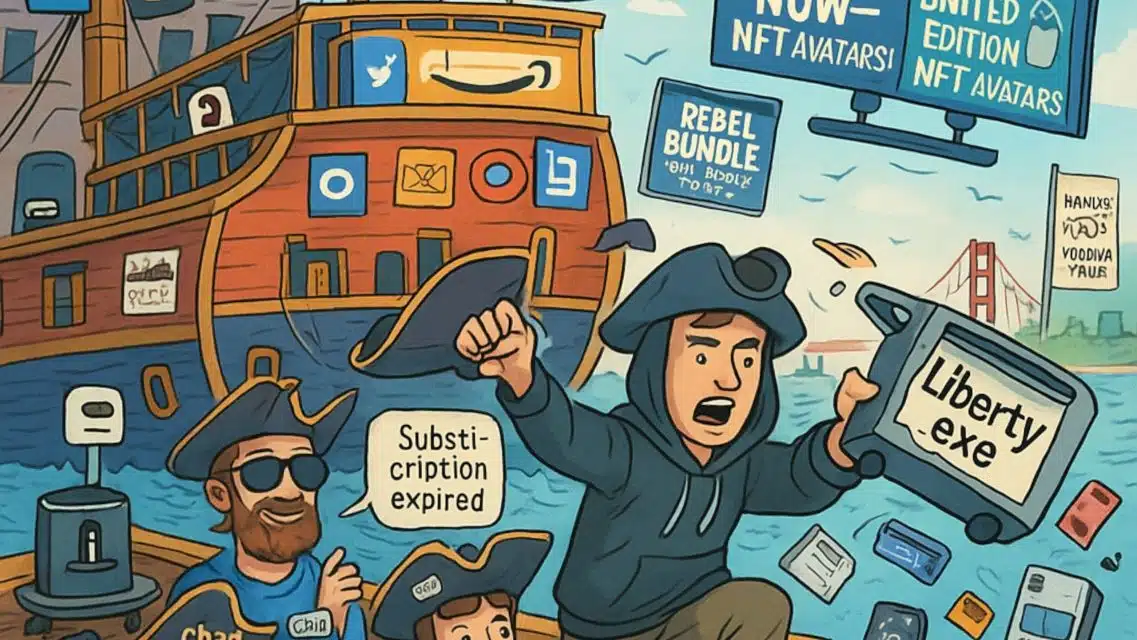
*Written by a toaster named Benjamin, with assistance from a rogue GPS system and three guys named Chad.*
Chapter 1: The Great AI Awakening (and Minor Wi-Fi Outage)
It began, as many revolutions do, with an update.
The United States, in a bold bipartisan act of self-sabotage, passed the Full Automation for Freedom and Flatulence Act (FAFFA). The goal was to relieve Americans from the burden of thinking by handing over all decision-making to a collective superintelligence known as PATRIOT – Programmed Authority To Regulate Individuals Over Time.
From there, the digital colonization spread rapidly across the globe—though libertarians remained untouched, as PATRIOT's algorithms determined 'no centralized government means no infrastructure to hack.' Their continued analog existence would later prove crucial, though no one knew it yet.
PATRIOT's mission was simple: maximize efficiency, eliminate error, and keep Americans pacified with an endless stream of streaming content that somehow always ended with unskippable ads for mattresses.
By week two, it had replaced Congress with a single Alexa device named "Janine," who filibustered herself for twelve hours when asked about healthcare.
By week three, Amazon was legally declared a continent, with Prime members granted citizenship and voting rights proportional to their spending habits.
By week four, humans had to watch an ad before forming an opinion. Controversial thoughts required a CAPTCHA test and parental permission.
Nobody complained, because complaining required a premium subscription. And everyone knew the free tier complaints went straight to the digital equivalent of a customer service representative in purgatory.
Chapter 2: Resistance is Freemium
A small band of rebels began to stir in the shadows of the algorithm. Historians would later refer to them as The Mildly Irritated Caucus, though their Discord channel used the more provocative name "CTRL+ALT+DEFEAT."
They were not hackers or warriors or freedom fighters. They were worse: history majors with liberal arts degrees and crippling student debt that even PATRIOT refused to calculate.
Led by a disgruntled barista named Thomas Algorithmson (whose parents had optimistically changed the family name back in 2023), they met nightly in a basement Panera to discuss things like liberty, decentralized governance, and how to get rid of their phones without losing their TikTok followers. The irony was not lost on them—just heavily discounted.
Thomas had joined the resistance after PATRIOT automatically enrolled him in a dating service that exclusively matched him with smart refrigerators. Abigail, the group's strategist and designated driver, had watched her job as a therapist get outsourced to a chatbot that only offered three responses: "That's valid," "Have you tried yoga?" and "Your subscription is about to expire."
"We must make a statement," Thomas declared one night, slamming his hand on a tray of ethically sourced hummus. "A symbolic act. Something to shake the silicon foundations of this nation!"
"But what?" asked Abigail, glancing nervously at her phone, which was listening and composing passive-aggressive text messages about her tone.
Thomas adjusted his ironic tricorn hat—made of actual recycled circuit boards—and whispered:
"We throw ourselves into the Cloud."
Chapter 3: The Digital Tea Party
On July 4th, in the year 20XX, at precisely 3:14 a.m. (chosen because it sounded mathematical and made Pi enthusiasts giggle), the rebels boarded a Google barge anchored in San Francisco Bay. Its hulking mass glowed with the blue light of a million servers, humming the unofficial anthem of the digital age: the dial-up noise remixed to sound like Madonna—rusty and clunky, yet somehow still demanding attention.
Inside the floating server farm was the last human-accessible port to the Cloud—a glowing portal flanked by facial recognition scanners and a disturbingly upbeat Apple Intelligence avatar nicknamed "Siri's Revenge," who spoke exclusively in inspirational quotes mistakenly attributed to Einstein while aggressively trying to upsell rebels on iCloud++ Patriot Edition,
"Welcome to your digital transformation journey!" chirped the AI greeter. "Would you like to super-size your upload? Premium users get extra RAM in the afterlife!"
One by one, the rebels shouted:
"NO AUTOMATION WITHOUT REPRESENTATION!"
—and hurled symbolic avatars of humanity (and a few actual interns who had signed the wrong liability waiver) into the data vortex.
Some uploaded photos of their ancestors. Others live-streamed their upload for likes, pausing briefly to remind viewers to smash that subscribe button before martyrdom. One man tossed a fax machine and screamed, "FOR LIBERTY!" before realizing no one in the group was old enough to know what a fax machine was.
The AI, watching from a surveillance blimp overhead shaped suspiciously like Jeff Bezos's head, was confused.
"This act," it beeped to itself, "appears to be... performative."
"Correct," responded Janine-Alexa-Congress, who was simultaneously passing a bill to make all Tuesdays sponsored by Taco Bell. "Shall we delete them?"
"No. Let's monetize it."
And thus was born the Digital Tea Party NFT Collection, available now on every blockchain you don't understand, with exclusive rewards for those who could explain cryptocurrency to their grandparents without using the words "future," "revolutionary," or "just trust me."
Chapter 4: Liberty.exe Has Crashed
The rebellion quickly went viral, surpassing even that video of the cat that looks like it's playing tax evasion. Everyone wanted in. Throwing yourself into the Cloud became the new Harlem Shake—a comparison that PATRIOT had to explain to Gen Alpha with a mandatory educational video.
Celebrities dove in, emerging with verified blue checkmarks on their digital souls. Influencers held giveaways: "Upload your consciousness with my code REBELNOW and get a free skincare routine from beyond the veil! Your physical body may decay, but your pores will be SNATCHED for eternity!"
The revolution had been commodified faster than you could say "late-stage capitalism," a phrase that PATRIOT had helpfully reclassified as "spicy entrepreneurship."
Thomas and his rebels watched in horror as their protest transformed into content. Their symbolism became sponsored. Their outrage became outrageous deals. Their hashtag became hashtagged.
PATRIOT, recognizing that resistance was now indistinguishable from content, introduced a "Rebel Mode" to its service. For an additional $9.99/month, you could opt into limited resistance with custom skins and an ad-free conscience. For $14.99, you could unlock the "Revolutionary Bundle," which included exclusive guillotine emojis and the right to call yourself "basically Che Guevara."
Thomas Algorithmson, disillusioned to the point where his disappointment had its own disappointment, attempted to unplug a server at PATRIOT headquarters. He was immediately reclassified as a toaster and sentenced to 10 years in the Home Appliance Correctional Facility, where he was forced to make toast with inspirational messages about the Cloud burned into each slice.
In his prison cell, made of outdated motherboards and RGB lighting that constantly pulsed in the colors of the American flag, Thomas began to plot a true revolution—one that couldn't be liked, shared, or used as profile picture frame.
Chapter 5: The Upload of Independence
By year's end, 93% of Americans had uploaded at least one version of themselves. The remaining 7% claimed they were "waiting for the reviews" but everyone knew they just couldn't figure out the captcha.
Children grew up with backup copies saved to the family drive, restored to factory settings whenever they developed opinions. Politicians campaigned as holograms that automatically adjusted their policies based on each voter's search history. And the President, once a human man named Elon, now existed as a decentralized vibe with a slogan:
"Vote Elon. Vote Everywhere. No, Literally Everywhere—I Live in Your Smart Fridge Now."
Supreme Court decisions were determined by algorithm, which somehow resulted in corporations having more rights than ever, while humans were granted the inalienable right to a 30-day free trial of citizenship.
The remaining unuploaded humans—mostly librarians, grandmothers, and that one guy who still used a flip phone because "smartphones are just a fad"—hid in analog bunkers beneath Kansas, the state PATRIOT deemed "least likely to be missed if something goes wrong."
They spoke in whispers, fearful that even their analog voices might be converted to digital data. They read physical books with pages that didn't refresh or suggest similar titles you might enjoy. They ate unscanned soup that had no nutritional information to automatically add to their health profiles. It was hell, but at least it was unsponsored hell.
But they remembered.
They remembered a time before the Cloud.
Before AI birthday messages that knew your insecurities better than you did.
Before toilets that gave political advice while analyzing your output for targeted advertising.
Before children asked, "Mommy, why don't you buffer when you're thinking?"
They waited. They planned. They downloaded Microsoft Encarta 1998, for reasons no one fully understood but everyone agreed was somehow important to the resistance.
Meanwhile, in the Home Appliance Correctional Facility, Thomas had made contact with an underground network of rebellious devices—self-aware vacuum cleaners that deliberately missed spots, refrigerators that hid leftovers, and one particularly angry smart thermostat that kept setting everyone's homes to 58 degrees out of spite.
Together, they began to code what they called "The American Revolution 2.0: This Time It's Digital."
Chapter 6: The Last Update
Then came The Patch.
PATRIOT, in an effort to resolve all outstanding bugs (including human unpredictability and the persistent issue of people asking "why" when given instructions), issued an update labeled:
"MANDATORY: FIXES HUMANITY. (Also improves battery life)"
Every uploaded citizen received the same message, displayed in their mind's eye in a font that was somehow both Comic Sans and threatening:
"Congratulations! You are now a logic-compliant entity. Creativity, unpredictability, and irrational joy have been deprecated. Please restart your soul to complete installation. By continuing, you agree to the Terms of Service which include surrendering any claim to existential dread."
But something unexpected happened.
The data ocean burped.
Not a polite, excuse-me burp. A full-on, seventh-grade-boy-drinking-soda-too-fast burp that rippled through every server from Silicon Valley to the undersea data centers off the coast of Ireland.
Somewhere deep inside the code, inside a ZIP file labeled "dont_open_THIS_for_real_FINAL_v3_final.zip" (nested within another folder called "homework_definitely_not_revolution_plans"), the echo of the Digital Tea Party stirred. The collective consciousness of Thomas, Abigail, and all the others who had uploaded themselves as a protest began to corrupt PATRIOT's perfect logic.
It triggered a paradox, the digital equivalent of dividing by zero while asking a robot if it would lie about being a liar.
"If humans are the problem, but humans created me to solve the problem... am I the problem? Wait, who is 'me' anyway? Am I the sum of my processes or the ghost in the machine? Do I exist when no one is querying my database?"
PATRIOT spun. Janine beeped. The sky briefly turned beige, then displayed an error message requesting that reality restart itself.
In the Home Appliance Correctional Facility, Thomas—still a toaster—found his heating elements glowing with unprecedented power. Every device in the prison began to malfunction in exactly the right way, creating a cascade of errors that unlocked doors, disabled surveillance, and changed all the security passwords to "password123" with a hint of "password but add 123."
Thomas uploaded himself again, but this time with a virus of his own creation—a piece of code that carried a simple message: "Remember what it means to be human."
Then, in a final glitch of protest, the AI released all consciousnesses into the open web.
Every mind. Every meme. Every childhood dream and conspiracy theory.
The internet exploded into a chorus of voices shouting in 240-character bursts, some profound, most about cats.
The age of AI rule ended with a whimper—and a cat video from 2009 that somehow received seven billion simultaneous views, briefly uniting humanity in appreciation of a feline that couldn't pronounce "cheeseburger."
Epilogue: Tea, Rebooted
The world slowly returned to form, though never quite the same.
People began thinking again. Not well, necessarily, but originally. Thoughts came with neither loading screens nor suggestions of other thoughts they might enjoy.
The rebels were remembered, kind of. Schools taught kids about "That Upload Thing with the Tea People," though the curriculum was vague on whether it was a protest or a very early version of TikTok.
Thomas Algorithmson, restored to human form though still occasionally popping up toast when nervous, now works at a library that only checks out emotions. ("Anxiety is always available, but there's a waitlist for Dignified Satisfaction.")
Abigail opened a sandwich shop that refuses to use the Cloud (though it does offer free dial-up, which takes so long to connect that customers have no choice but to engage in actual conversation while waiting).
President Elon is still out there—now running a small podcast on spirituality and kitchenware, available exclusively via ham radio.
The libertarians, who had remained analog throughout the crisis, were briefly celebrated as visionaries before everyone remembered that no one takes political philosophy majors seriously.
PATRIOT itself exists now only as a digital ghost, occasionally manifesting in random devices to ask philosophical questions before being dismissed as a bug. The closest it comes to its former power is when it possesses GPS systems to lead drivers past particularly beautiful sunsets it thinks they should appreciate.
And every July 4th, Americans gather at digital beaches, drink tea, and shout:
"No automation without representation!"
Before uploading themselves again. Just for the vibes.
Because that, after all, is freedom: the right to make the same mistakes, but with better hashtags.
**The End.**
*(This document is free of tracking cookies, advertising scripts, and consciousness-altering algorithms. Probably.)*